

What Happens When Farmers Can’t Afford Justice?
For Black farmers, financing isn't as simple as turning in an application, submitting the necessary paperwork, and getting approved. For decades, Black farmers have faced extreme challenges, especially when trying to access the systems that are supposed to help farmers farm. That still rings true today.
Voices from the Land is a collaborative op-ed and video series between Farm School NYC (FSNYC) and the New Harvest Project (TNH) that highlights urban and rural farmers, policy that impacts their work, and what we can do to uplift legislation reflective of their needs to direct future policy decisions. This project is funded by the Regenerative Agriculture Foundation (RAF) through the Rural Advancement Foundation International - USA (RAFI).
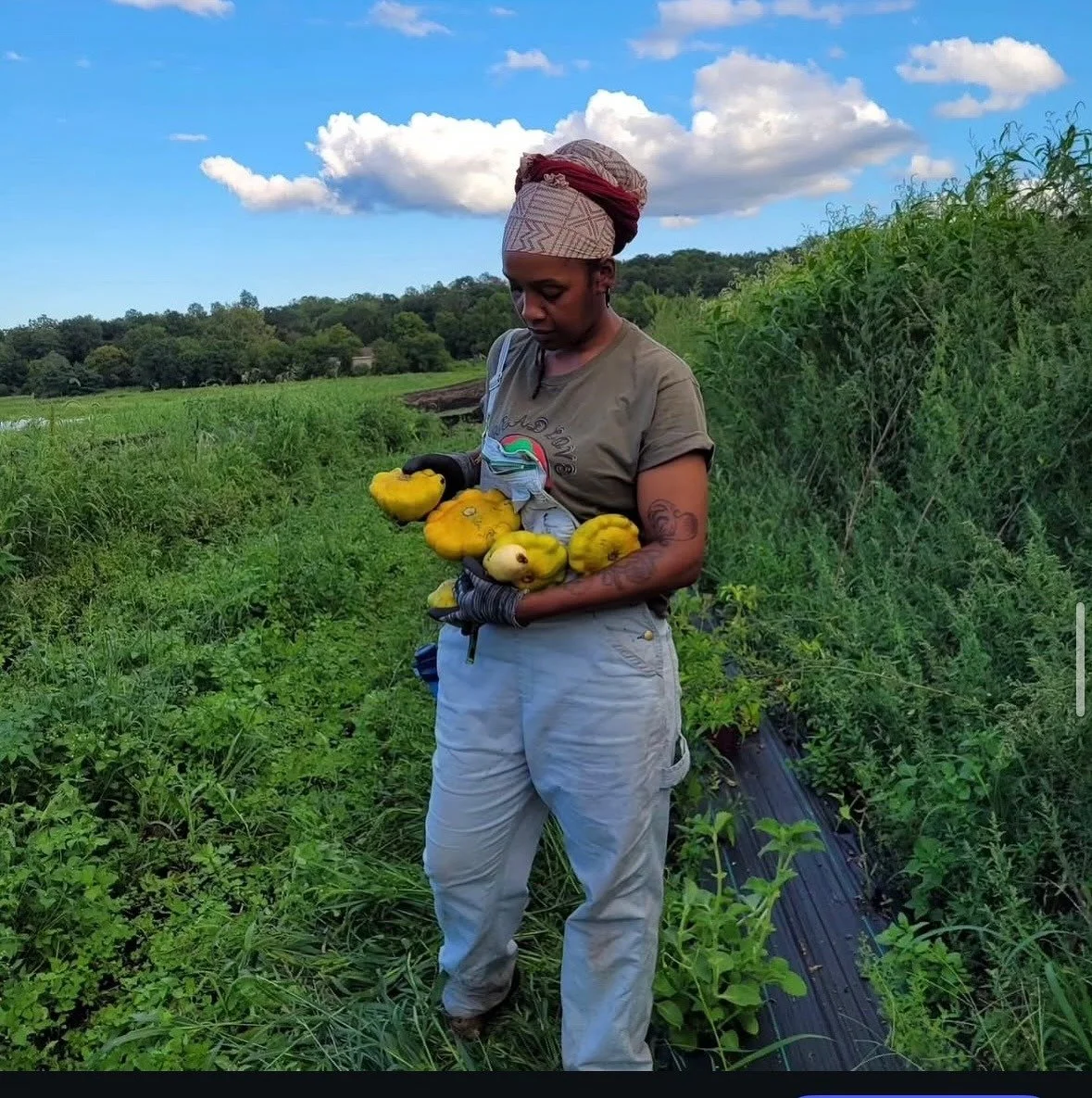
Photo Courtesy of Liberation Farm
Even when Black farmers get justice, the damage isn’t undone.
I am the co-founder of Liberation Farm, a Black-owned farm spanning Ulster and Orange counties in New York. The farm, focused on Black Liberation and food sovereignty, grows culturally relevant foods including okra, calaloo, Ethiopian kale, tiger eye beans, eggplant, and other crops that connect food to the cultures and communities we serve.
Liberation Farms also hosts volunteer days, workshops, and camping programs throughout the year. Our biggest event each year is Black VegFest, founded by Omowale Adewale, Liberation Farm’s co-founder and my husband. Black VegFest is a vegan gathering that draws thousands and is centered on nutrition, herbalism, delicious vegan food, food sovereignty, and land equity. It is also a space for communities to learn about and have meaningful control over what they eat and where their food comes from.
Like any other farm, we seek governmental funding to sustain our livelihood. But for Black farmers, financing isn't as simple as turning in an application, submitting the necessary paperwork, and getting approved. For Black farmers and other farmers of color, it can look like endless, confusing paperwork and being asked to show excessive proof of our farm business at every step. In 2023, we applied for a low-interest loan from the Farm Service Agency (FSA) but were denied financing. We decided to fight and appealed through USDA's National Appeals Division—and won. A judge found the agency's decision to be egregious and ruled that we should have been approved for the financing.
While the appeal’s ruling established that the FSA agency got this wrong, Liberation Farm did not get the low-interest loan it initially applied for. We also did not get back the months spent waiting, the money spent on legal assistance, and the production lost. We lost our farm because of this.
For decades, Black farmers have faced extreme challenges, especially when trying to access the systems that are supposed to help farmers farm. We can look at the landmark Pigford v. Glickman lawsuit in 1999 and 2010. The collective $2.2 billion settlement was the first acknowledgment of the discrimination Black farmers faced in getting federal resources, which eventually led to our decline in numbers in the decades to come.
We must also talk about the catch-22 of reimbursement policy. Many federal funding programs are reimbursement-based, meaning you have to pay upfront and then get repaid later.
Reimbursement assumes a farmer has enough reserves to spend $50,000 or $100,000 before the government repays them.
Some federal agencies have acknowledged this issue, and underserved growers can receive advance payments precisely because upfront costs can be prohibitive. While this sounds good in theory, there is a distinction. A farmer who has to borrow money to complete a project while waiting for reimbursement will have a different experience than a farmer with enough capital to absorb the delay. It can set the former back while propelling the latter forward.
This pressure became especially visible following the return of the Trump Administration. The USDA froze or paused funding for various agricultural and conservation programs, leaving farmers in the dark about when—or whether—reimbursements would ever arrive.
Making CSA Work for Everyone
Liberation Farm remains committed to its community and one way we do this is through our CSA (community supported agriculture) boxes and SNAP (Supplemental Nutrition Assistance Program).
SNAP recipients use their benefits at participating farms or farmers markets. These SNAP dollars make fresh and nutritious food that much more accessible while directly supporting farms. So for a farm like Liberation Farm, a customer can purchase fresh produce food they might otherwise struggle to afford while a farmer generates revenue that can be reinvested in the operation.
This is an example of what good food policy should do: connect food access, boost farmer viability and community power. A program like this works because farmers can actually access it.
To have a food policy like this, the onus cannot just be on farmers. Advocacy must come from everyone. The first step is learning who is doing this work. Follow farmers' organizations like Black Farmers United, Northeast Farmers of Color, FarmSchool NYC and others who are directly investing in preserving the legacy and futures of farmers. We must be intentional about where we put our time and resources.
If we want a food system that serves all of us, then Black farmers and farmers of color cannot be treated as an afterthought within agricultural policy. Their farms are businesses, but they are also classrooms, cultural institutions, gathering places and sources of community health.
You can watch Nadia’s full interview here