

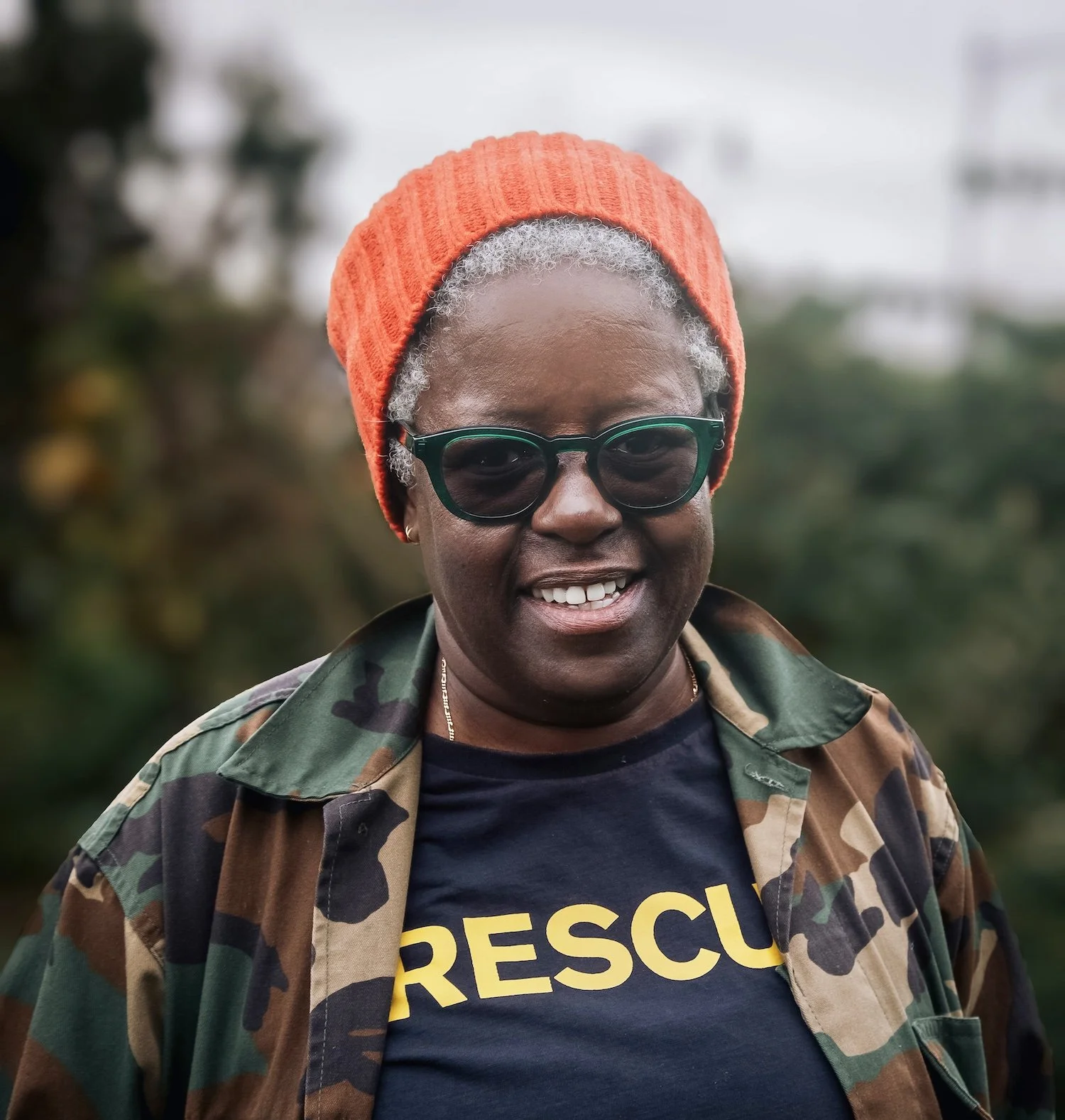
Food As the Entry Point
Food is the entry point to advancing justice as it is communal, cultural, and conversational. Here’s how Sheryll Durrant, steward or the Kelly Street Garden and IR”s New Roots Program sees food as infrastructure
Voices from the Land is a collaborative op-ed and video series between Farm School NYC (FSNYC) and the New Harvest Project (TNH) that highlights urban and rural farmers, policy that impacts their work, and what we can do to uplift legislation reflective of their needs to direct future policy decisions.
This project is funded by the Regenerative Agriculture Foundation (RAF) through the Rural Advancement Foundation International - USA (RAFI).
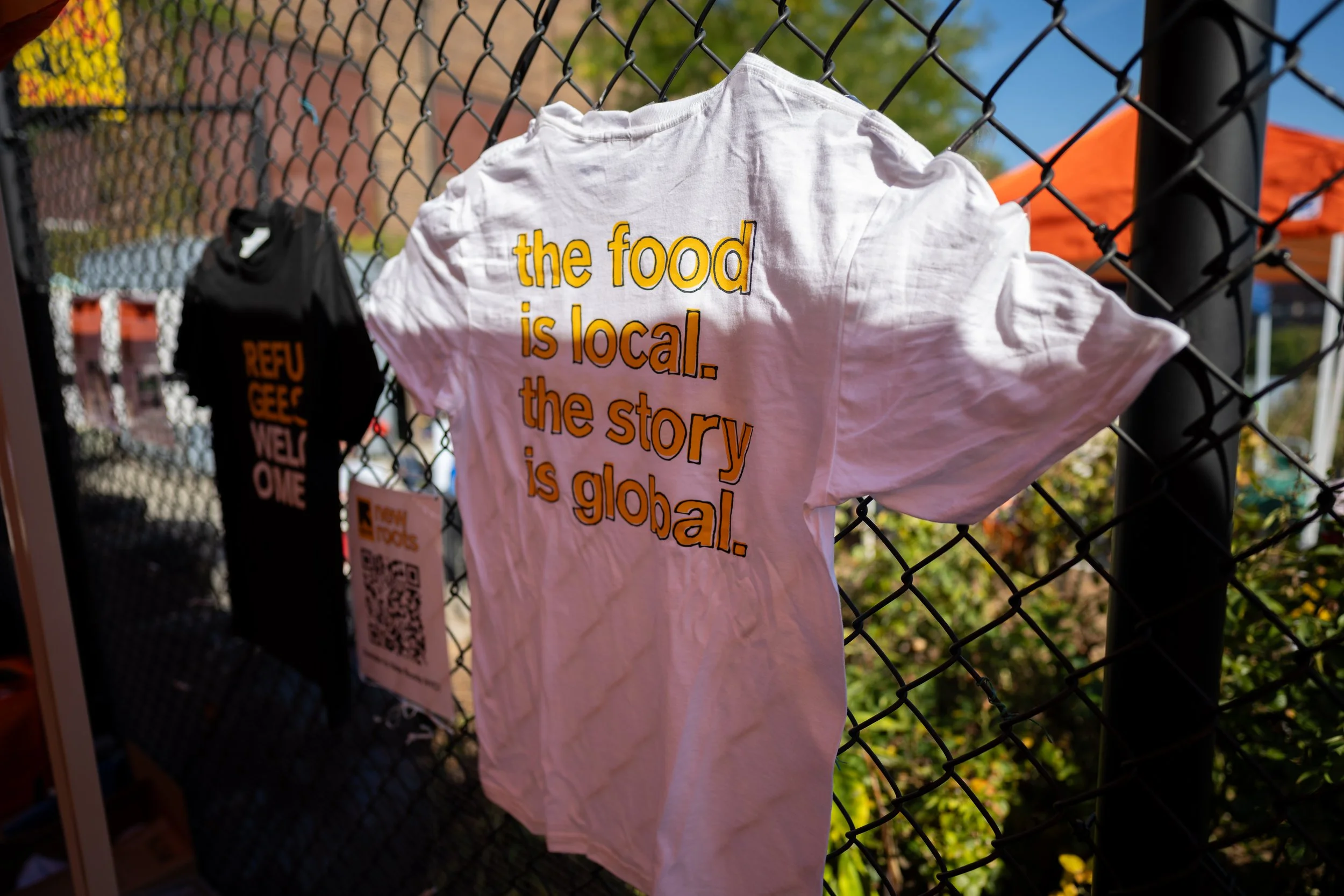
Food is the entry point to advancing justice as it is communal, cultural, and conversational.
It’s also a critical part of breaking down barriers and a way for people to get to know themselves. Food may seem like a simple entry point, but it is also a part of a fundamental truth: food is infrastructure.
It is as essential to a functioning society as housing, transportation, and energy. But often, food and these very same issues are thought of, solved for, and regulated in silos. This also contributes to the failure to treat the city’s deepening inequality, worsening public health, and accelerating climate vulnerability.
But there is a different model we can turn to, as I am living it.
My food justice work takes place in two primary spaces. The first is that I’m the food and agriculture coordinator for the IRC New Roots Program, a green space program open to refugees, immigrants, and recent asylum seekers, focused on food access and education. Alongside free educational workshops, the program also holds community-based farms. The first is a half-acre farm in the South Bronx, off the Grand Concourse, and a smaller community garden in Woodside, Queens. All community members in the New Roots Program are welcome to come and get free produce, no questions asked. Sometimes people approach with a kind of shame in the fact that they are food insecure, and we want to dispel that. Many people,across New York City, particularly those in my community of the South Bronx, are food insecure. I want to make clear that these people are the working poor—meaning we work and are employed, but still have to juggle expenses such as rent, utilities, medical bills, and groceries.
The other space I tend to is the Kelly Street Garden, which is where I call home. The garden runs along the back of four affordable housing buildings and is embedded in the community. I extend the same level of care and programming here as I do with the IRC New Roots Program. Growing up in Jamaica, my mother would tell us to go pick something in the yard for dinner. I never realized then, but looking back, we were wealthy because we were on our own land. My father would grow watermelon, mangoes, oranges, lemons, corn, breadfruit, and so many other vegetables and fruit. Now as I steward the Kelly Street Garden and work with the New Roots Program, I remember how privileged I was growing up.
But outside of those spaces, nowhere is the food system disconnect more visible than in the South Bronx.
The Hunts Point peninsula is home to one of the largest food distribution centers in the country, with 4.5 billion pounds of food passing through its Food Distribution Center each year. Yet much of that food never reaches the people in the immediate area. While the center is critical to the entire region, its aging infrastructure, the pollution it brings to the surrounding area, and its location in a flood zone make it no longer sustainable. The environmental pressures it imposes on the South Bronx exacerbate many of the area’s health issues. Heavy-duty trucks come and go from the hub at all hours, and just a few blocks away is the Bruckner Expressway, which adds further environmental pressure.
This is not an accident. Intentional policy decisions have concentrated these burdens in already marginalized neighborhoods.
Climate Policy Must Include Food Systems and Land Access
Urban agriculture is also climate policy.
New York is a concrete jungle. And we continually prioritize this kind of landscape despite intensified heat, flash flooding, and increased air pollution impacting the city. Community green spaces counteract these effects. We know that these green spaces absorb stormwater,reverse the heat island effect, and improve mental health—so why aren't we building that way?
To me, this is a policy failure.
If lawmakers are serious about climate resilience, they must move beyond siloed approaches. It's not just about affordable housing or maximizing land use. It’s about paying attention to what makes a livable city. When you integrate the natural environment, we can then begin to properly address housing, education, and public health. My request for urban planners is to think about how you can push the boundaries of greening a building. How can vegetation grow on the side of a building? How can we have more permeable surfaces for water to penetrate? This is how we move toward climate adaptation.
Climate adaptation directly connects to a more just and sustainable system. This can start with food sovereignty. Land should be for the commons, and farmers and communities should have control over how food is grown, distributed, and consumed. All of us should have access to and be able to steward land and grow the types of culturally relevant food we need. This kind of sovereignty would require us to be in deep community. But as of now, the only way to have access to land is through monetary gain. That is part of a larger conversation of colonialism and capitalism.
Access to land is the foundation of any community-led food system. Without it, food sovereignty is impossible. Yet here in New York City, land access remains one of the greatest barriers to scaling community agriculture. We cannot continue to have just a few people owning the means of production. Even farmers who believe in mutual aid, are mission-aligned and justice-oriented, have a hard time embracing food sovereignty because the current system just does not favor it.
One promising concept introduced by Mayor Mamdani is the city-owned grocery. This aligns with my belief that food should be free or, at the very least, low-cost and accessible. However, will these grocery stores be connected to the local food system? Local and regional farmers need to be brought to the table as this could be a critical entry point to make the city self-sufficient. City-owned grocery stores could also be what takes the food and agricultural economy out of corporate hands.
Investing in the Next Generation
We need to equip the next generation with the tools and lessons to achieve community-led food systems. More intergenerational spaces and more opportunities must be created for young people to lead. The community gardening movement in New York has long been sustained by grassroots organizers—many of whom are now aging out of leadership roles. Without intentional investment in younger leaders, knowledge and infrastructure could be lost.
A more just and sustainable future will not come from maintaining the systems we have—it will come from having the courage to dismantle them and build something rooted in land, care, and collective responsibility.
You can watch Sheryll Durrant’s full conversation with Iris M. Crawford-Maskell here.
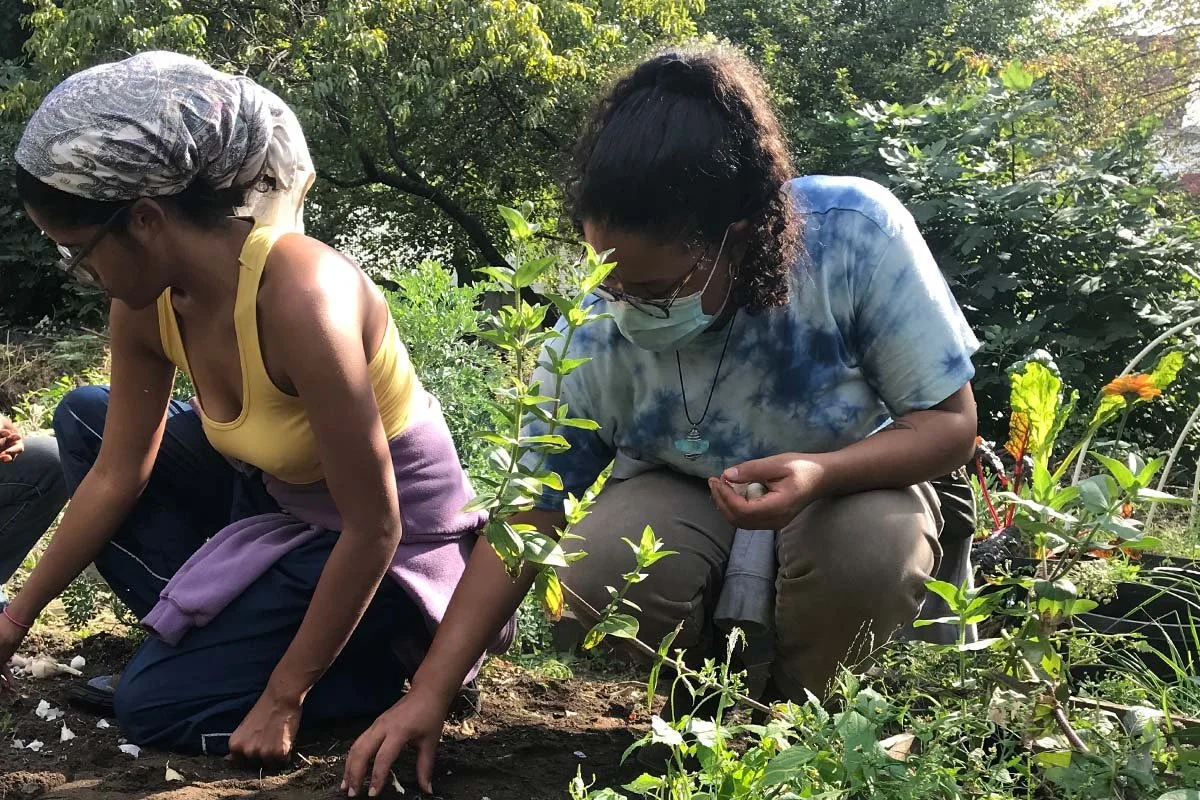
If Farm School NYC Closes, What Will the City Lose?
On a humid Friday evening in early September, staff at Farm School New York City (FSNYC), an urban agriculture education organization, called an emergency town hall to share a critical update. They were at risk of closing—as early as the end of the year— and were starting an emergency fundraiser with a $250,000 goal. FSNYC staff shared that federal funding cuts had further deepened their funding gap and put their work with various community partners in jeopardy.
On a humid Friday evening in early September, staff at Farm School New York City (FSNYC), an urban agriculture education organization, called an emergency town hall to share a critical update. They were at risk of closing—as early as the end of the year— and were starting an emergency fundraiser with a $250,000 goal. FSNYC staff shared that federal funding cuts had further deepened their funding gap and put their work with various community partners in jeopardy.
FSNYC equips NYC-based residents with the tools, training, and support needed to practice sustainable agriculture and advance food sovereignty, food justice, and liberation. It is one of the few urban agriculture education spaces that has a sliding-scale tuition model, making it accessible to everyone. With proper funding, organizations like FSNYC equip learner farmers and land stewards with the knowledge to build sustainable businesses, forge food justice movements, and rebuild relationships with the land. If FSNYC is forced to further reduce capacity or permanently close, what historical, cultural, and institutional knowledge will New York City lose?
An Uncertain 2025
This year has been full of questions and meetings for the organization’s staff, board, and alumni network. “At the same time, we are trying to figure out what will happen with our jobs and our programs,” said Frances Pérez-Rodríguez, the program coordinator for FSNYC, in an interview with NPQ.
In 2024, FSNYC applied to several federal programs administered by the United States Department of Agriculture (USDA) and the United States Environmental Protection Agency (EPA), including the USDA Urban Agriculture and Innovative Production Grant program, Farm Service Agency Grants and Cooperative Agreements, and the Thriving Communities Grantmaker Program, among other opportunities. Its largest federal grant is part of a 27-organization cooperative agreement.
“We had organizations giving microgrants out to farmers, uncertain if they would get that money back and when,” said Dyaami D’Orazio, FSNYC’s programs director, in an interview with NPQ.
Once the Trump administration transitioned in early January, FSNYC’s grant awards kept getting delayed and were eventually frozen. This put the organization in immediate limbo between January and May. During that time, D’Orazio said, “we were planning our programs and starting to sound the alarm about whether Farm School was going to be able to make it.”
In analyzing their cash flow, staff worried that the organization might have to close as early as August. By early spring, FSNYC had to lay off three staff members, and reduce hours for some of the remaining staff. Fueled by a strong desire not to disrupt programming, FSNYC leaders successfully petitioned the federal government to apply for reimbursements. But while they were able to recover some funds, they are nowhere near being in the clear.
“Our cash flow is still uncertain, and we [still] have a pretty big gap,” D’Orazio said.
FSNYC has been operating at a deficit for some time, still striving to provide good pay and benefits for its staff. Despite these challenges, the organization has been able to maintain relationships and tap into its network.
The Way Forward
The current gap in FSNYC’s funding is $500,000—the amount needed to get them somewhat comfortably into 2026, keeping staff at full capacity with benefits. Most recently, FSNYC received a one-time $100,000 emergency grant, but that is just enough to close the gap for the rest of 2025. The organization’s fundraising campaign remains open for support.
At the emergency town hall, attendees discussed options for the organization’s future that included a possible merger and implementing a subscription model for FSNYC’s offerings.
“People are shocked, worried, and activated to help in ways that they can,” Pérez-Rodríguez said.
One critical part of FSNYC’s ethos is being part of the Black Farmer Ecosystem, a collective working to shift power and ownership to Black farmers in New York through advocacy, policy, and capital. The Ecosystem includes FSNYC, Soul Fire Farm Institute, Northeast Farmers of Color Land Trust, Black Farmers United-NYS, Corbin Hill Food Project, and Black Farmer Fund. Pérez-Rodríguez explained that the ecosystem is figuring out how they can better align to further fortify the network.
Within the US context, farming has always been political for land stewards and farmers of color. “We teach urban agriculture but also have a social justice focus,” said Cris Izaguirre, a farmer, cultural worker and facilitator at FSNYC.
While American agriculture has actively sought to erase the knowledge and contributions of Black and Indigenous farmers, the organization makes a point to work in partnership with many queer, trans, and BIPOC growers managing farms and gardens across the city and state.
“No one wants Farm School to close,” Izaguirre said. “Oftentimes we don’t always see the long-term impact of our work, but seeing alumni out in the field, and applying the resources and skills that they learned during their time at Farm School makes it all worth it.”
Existing in the Current Moment
When asked whether FSNYC would apply for government funding again, Pérez-Rodríguez emphasized that “nothing that the government creates is for the benefit of QTBIPOC people.”
The US government, they explained, particularly under the current administration, is actively working to oppress and exploit the bodies and labor of QTBIPOC people.
“That is the framework that most people at Farm School are coming to the work with,” Pérez-Rodríguez said.
The Farm School community has urged the organization to stop relying on government funds because of how quickly it can be taken away. “It is hard to keep asking our oppressor for this when it is owed to us,” said Pérez-Rodríguez.
At the same time, the organization is wrestling with the fact that in the past it was able to leverage government funds to expand its work. The next phase for FSNYC, as for many nonprofits across the sector, is determining how to depend on its network with more creative streams of revenue.
“With the current administration, there are DEI words that we can’t even use in order for our funding to not be cut,” said Izaguirre. All those words, he explained, encompass exactly what the organization does and stands for.
“How do we exist in this [current] world and in these [grant] proposals when the government is clearly saying: You cannot have this money?” said Izaguirre. Along with attacking the agriculture and farming industry, the current administration is taking away basic rights and resources.
“It is so clear to me that the impact of our work is in our students,” D’Orazio said. “The most powerful part of Farm School is that we are helping people understand the reality of what it takes to get food on someone’s table.”
This story also appears on NPQ