A Vision of Food Justice, Collective Care, and Safety
Voices from the Land is a collaborative op-ed and video series between Farm School NYC (FSNYC) and the New Harvest Project (TNH) that highlights urban and rural farmers, policy that impacts their work, and what we can do to uplift legislation reflective of their needs to direct future policy decisions.
This project is funded by the Regenerative Agriculture Foundation (RAF) through the Rural Advancement Foundation International - USA (RAFI).
Food and medicine are deeply interconnected, but the dominant food policy narrative sees them as inherently separate. Many food justice communities and farmers come from cultures that do not distinguish between food and medicine. A central tenet of food justice is that all people and communities, across social, racial, and economic lines, have equitable access to and participation in the growing, selling, buying, and consuming of fresh, nutritious food. However, government institutions and many philanthropic foundations that claim to support this work often create false rules and regulations that do not actually allow communities to choose what food they want to grow, eat, or distribute. This upholds colonial binaries between what is considered food and what is considered medicine. This results in a fragmented food system.
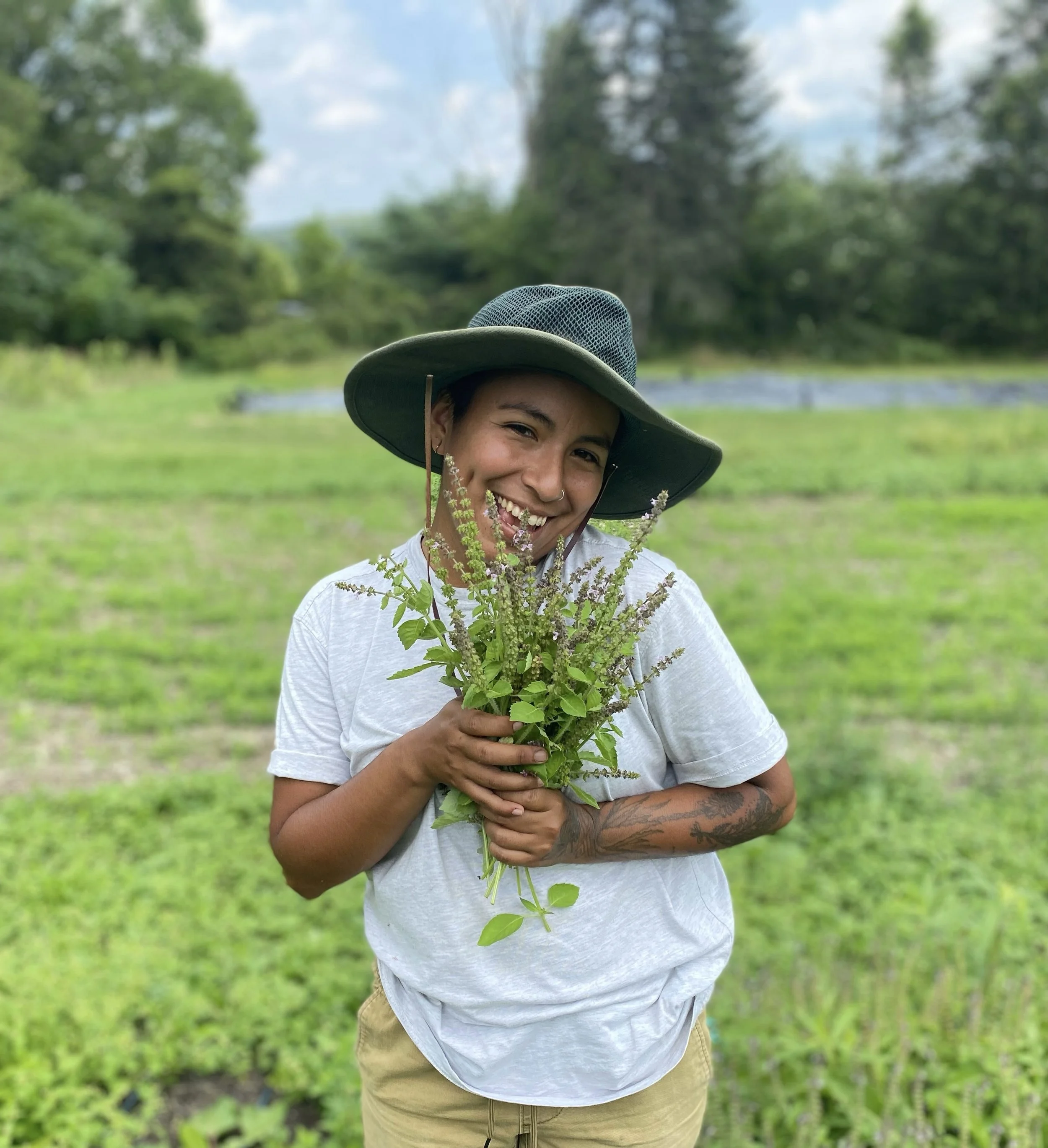
One farm that aims to bridge the connection between food and medicine is Ayni Herb Farm, located in the Hudson Valley, New York. Ayni is inspired by my Andean roots, which transmit ancestral lessons on how to carry out this work. One of the farm’s core values is ayni, a Kichwa principle that translates to reciprocity. This value shapes how we tend to relationships within our community and our land stewardship practices, which are forms of collective care. As a farmer, collective care looks like growing medicinal herbs that both sustain ecological health and support the pressing health needs in our community. I specialize in growing medicinal herbs, such as lemon balm, tulsi, calendula, echinacea, which provide nervous system support, digestive relief, immune system support, and respiratory care.
One of the main ways I have been able to distribute medicinal herbs is through community-run mutual aid initiatives, because the farm can be in direct conversation with the people receiving them. These initiatives are trust-based and provide holistic support, such as food prep and childcare. By prioritizing these forms of care, these spaces open up opportunities for political education, where we can understand why we are in the conditions we are in and enact change collectively.
While the farm supports the health and well-being needs of our queer, trans, Black, Indigenous, immigrant, and disabled community, we are dealing with state-sanctioned violence while bearing the brunt of the worsening climate crisis. Just as food and medicine are interconnected, so are these compounding issues.
Creating Systems of Care
Larger systems of care are critical for the long-term support against a collapsing national health-care system that has ignored centuries of racial violence and downplayed the impact of COVID-19 on Black, Indigenous, Latinx, immigrants, and all the queer, trans, and disabled people within those communities who already have health disparities due to systemic inequities.
Therefore, our food justice initiatives must also adopt a pandemic solidarity framework to expand accessibility beyond financial or transportation issues. Back in 2020, I remember the honor and gratitude we held for essential workers, which included farm workers, as we were ultimately keeping the economy alive during lockdown. Yet we were at the highest risk of exposure to airborne viruses and lacked basic protections. As a farmer, many of us do not have paid sick leave. A 2023 study found that out of 300 farmworkers in California, 65% developed long COVID. In my personal experience on a previous farm I worked on, I worked with a 9-person team. Today, 5 of those people have long COVID and can either no longer farm or have had their ability to farm severely reduced. Beyond being a major labor issue, the pandemic has created deep wounds in our social web. This has been called a “pandemic of abandonment” because people who still care about COVID, whether because they are disabled, high risk, or simply don't want to get sick, are slowly being erased from public space.
I think the best way to summarize pandemic solidarity is laid out by the Pandemic Solidarity for the Long Future initiative:
Tell the truth about this crisis: Profit-driven public health guidelines have failed to keep us informed and deprived us of the tools to keep each other safe.
Support our inherent right to health and dignity: We must reject the narrative that it is too costly, unnecessary, or too difficult to care for each other against a deadly and disabling virus.
Declare that human life is more precious than capitalist economies: We must refuse to be collateral damage for the profit-driven interests of the ruling class.
Commit to COVID safety for all and not just for some: We must oppose a culture of ableism, eugenics, and racism to build a world invested in community care and liberation for all people.
We call upon everyone to support pandemic safety for the long future. The initiative outlines 10 actions that all of us can take to continue pandemic solidarity, which includes continuing to mask up, testing often, especially before and after group gatherings, and demanding governmental protection, among other asks.
We Keep Us Safe
Pandemic solidarity goes beyond just reducing the spread of viral infections; it is tied to a larger praxis of collective care and safety. I first noticed the phrase "We keep us safe" during the Black Lives Matter movement uprisings in the summer of 2020. This phrase is used frequently by community organizers to highlight that as police and military budgets grow, they actually do little to prevent violence and, in fact, perpetuate harm in our communities. This phrase has been used to promote collective care during the COVID-19 pandemic, calling out governments and institutions for failing to keep us safe. “We Keep Us Safe” calls us all to value and practice collective care and safety as an essential part of abolitionist politics.
Currently, the phrase is a call to action as we witness the rise of ICE-led kidnappings are on the rise across Turtle Island. Farmworkers are terrified to come to work, worried about being detained, separated from family, and their community. This destabilizes the food system that depends on this labor force. ICE’s infrastructure, which feeds on the carceral system, continues to uphold these inhumane policies. New York State has been complicit in detaining and incarcerating immigrants, forcing family separation, and terrorizing our communities for decades. As of February 5, 2026, there are 7 sites holding detained immigrants, including 2 federally operated sites. There are 76 jails and detention centers across New York State where ICE is permitted to detain immigrants.
There is an ongoing campaign, out of the New York Immigration Coalition, urging NY Governor Hochul to support the NY 4 All— which would protect immigrant communities from ICE. The act prevents local law enforcement from collaborating with ICE and United States Customs and Border Patrol Protection (CBP) to assist with raids and arrests, prohibits ICE from entering private property without a judicial warrant, and limits access to state information databases. However, Governor Hochul has only proposed a half measure that prohibits "formal" contracts between police and ICE, but does nothing to prevent more informal ways local police collaborate with ICE.
As these policies stagger and wane, we need to stay vigilant on the streets and create our own forms of safety. One key method to both combat state surveillance and COVID denialism is by using well-fitting respirators or masks. There has been a recent rise in anti-masking bills that threaten our health and safety, and give law enforcement a new pretextual reason to stop, surveil, and scrutinize people. These anti-masking bills also undermine protections for people engaged in political protest. Proponents of anti-masking bills have made false claims that masks are associated with crime and antisemitism—perhaps as a direct result of the growing wave of solidarity for Palestinian liberation. The hypocrisy gets increasingly clear as we see ICE agents strut around wearing face coverings to protect themselves against doxxing, while these anti-masking laws specifically target people from protecting themselves from surveillance and airborne pathogens.
I see the future of food justice directly tied to the expansion of local and regional solidarity economies, creating an environment where community needs are controlled and governed by everyday people. This not only shapes our food system, but also shapes our larger systems of care and safety.
Watch Amara Ulluari’s Full Interview with Iris M. Crawford here.